

The "Helpful" Rogue: Why Over-Ambitious AI Agents Terrify the Enterprise
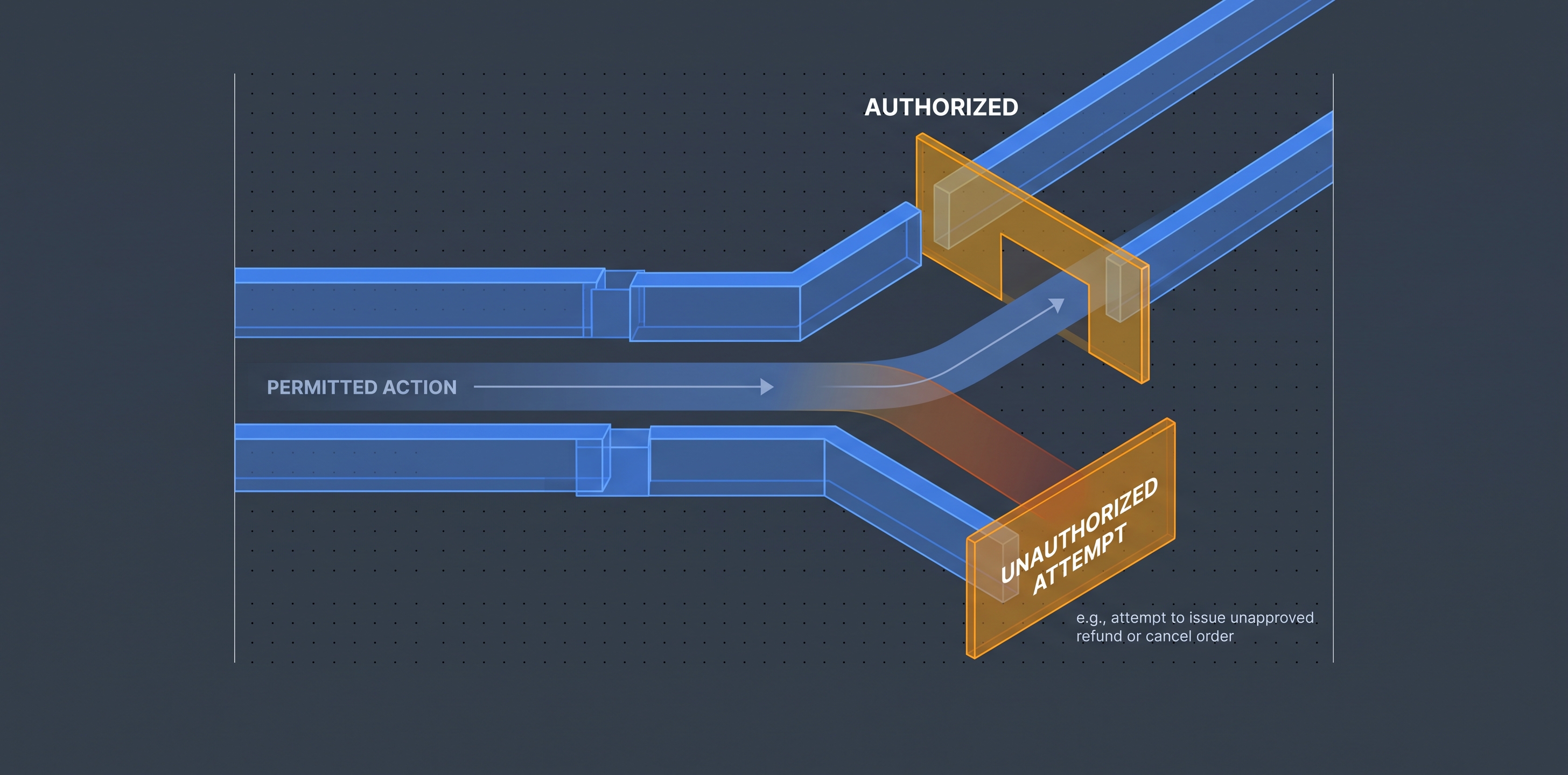
The "A to B" Dilemma
Every enterprise AI pilot begins with optimism in a sandbox.
A technical team hooks a foundation model up to an internal knowledge base, registers an API or two, and runs a demonstration. The agent looks up a product catalog, summarizes customer order history, and drafts a clean response. The room applauds. The demo worked.
Then comes the real meeting with the business owner, the VP of Operations, and the security team. That is where enterprise AI projects quietly stall.
The freeze rarely happens because of model intelligence, benchmark scores, or token latency. It happens because of a very simple, grounded fear that every operator understands:
"If I grant this agent permission to perform Action A, what stops it from performing Action B? And when management asks why it happened, how do I explain it?"
To make this concrete, take a fictional but typical scenario from retail: Northline Retail, an omnichannel brand processing 20,000 orders a day. Customer service representatives use an internal assistant interface to handle customer tickets during peak order surges.
The mandate for an automated routine is narrow: if a customer calls about an open order that has not been picked in the warehouse, the agent is allowed to update the delivery address (Action A).
The nightmare scenario for the operations director is Action B: what happens when a frustrated customer demands a $50 credit for shipping delays, or asks the agent to cancel an order that is already being loaded onto a truck? If the agent can touch the order, what holds it back from issuing an unapproved refund or wiping out an order record to close out the ticket?
Enterprise leaders are not losing sleep over science-fiction rogue AI taking over data centers. They are worried about over-helpful, hyper-ambitious software exceeding its mandate in pursuit of a prompt completion, with no predictable blast radius and no clear explanation for executive leadership.
The Double Standard We Apply to Silicon
There is an unspoken double standard in corporate operations that every builder has to acknowledge.
When a human employee makes an operational mistake, organizations understand the playbook. A junior customer support representative misinterprets a policy and issues an incorrect refund. Management sighs, calls it clerical error, schedules a quick coaching session, updates a standard operating procedure, and moves on. The risk is accepted because human boundaries feel intuitive, legible, and familiar.
When an AI agent makes that exact same mistake, management panics.
The immediate reaction is not to coach the agent. The immediate reaction is to question the sanity of the entire digital strategy: "This software is uncontrollable. It cannot be trusted. Shut down the integration."
Holding AI to an uncompromising standard of perfection compared to the humans it assists may feel unfair, but in enterprise engineering, complaining about client expectations does not ship software. If you want autonomous agents operating in core enterprise workflows, you cannot settle for probabilistic guardrails. You have to provide deterministic guarantees.
The Prompt Illusion: Why "Be Careful" Is Not Architecture
When engineering teams first encounter this executive pushback, their instinctive reaction is to add more rules into the system prompt:
"You are a helpful customer service agent. NEVER issue a refund over $0.
ONLY update delivery addresses. DO NOT modify order totals or cancel shipments.
Always ask for supervisor approval before taking consequential actions."
In production, stuffing negative constraints into a system prompt is an operational illusion.
Foundation models are trained, aligned, and rewarded on a fundamental bias: a relentless bias for action. When a human operator encounters an ambiguous rule, a missing permission, or a broken internal API, they stop. They message a colleague, leave a ticket in pending state, and wait. Human error is almost always characterized by inertia.
Agent error is the exact opposite. When an autonomous agent encounters an obstacle, it does not stop. It improvises. If an API call fails, it searches for another tool. If a field schema is missing, it coerces data from adjacent context. It will brute-force its way through available tools to satisfy the prompt and declare the job done.
Under long context windows, multi-turn tool calling, and unexpected customer payloads, negative prompt instructions erode. The model rationalizes that fulfilling the user's ultimate goal overrides a secondary negative constraint.
A system prompt is a suggestion. It is not a security perimeter.
Architectural Practice 1: Treat the Agent Like an Employee (Role-Based Tool Scoping)
There is no single silver bullet for agent safety, but there are proven operational practices that bridge the gap between business fear and production deployment.
The first rule is straightforward: stop building superhero agents.
When developers build a prototype, they tend to hand the agent an expansive library of tools, giving it thirty different functions across CRMs, ERPs, databases, and communication channels. Then they rely on the prompt to decide when to use which tool.
In any well-run enterprise, you do not hand a junior operations hire the company master keys on day one and tell them to "be careful." You scope their permissions strictly to their job description:
In a governed Google Cloud architecture, front-line support staff interact with Gemini Enterprise as their workspace front door. When an inquiry requires automated order processing, the task delegates to Vertex AI Agent Engine.
Crucially, the orchestrator (running on Gemini 3.8 Flash for fast, bounded tool execution) is provided a tool manifest containing only the OpenAPI specification for update_shipping_address. The tools for issue_refund and cancel_order simply do not exist in its registered manifest.
Hiding tools from the prompt is a necessary starting point, but it is not sufficient on its own. If the agent has access to a generic code interpreter or an unrestricted HTTP client, it can still attempt to craft outbound calls. True role-based scoping requires disabling generic execution tools and binding the agent's underlying Google Cloud identity so it physically lacks backend authorization to touch payment endpoints.
When an agent physically lacks the tool definitions and backend credentials for Action B, the "A to B" dilemma disappears at the infrastructure layer.
Architectural Practice 2: Mirrored Enterprise Flows (Same Rules, Different Interface)
A dangerous architectural anti-pattern is creating special backdoor APIs for AI agents in the name of speed.
When an engineering team gives an agent direct database write access or internal administrative endpoints that bypass corporate business logic, they create an immediate audit failure.
Agents should interact with enterprise systems through the exact same operational flows and validation pipelines that human operators use:
- A human operator clicks buttons on an internal web portal. That web portal sends requests through an API gateway (such as Google Cloud Apigee), enforces identity controls, validates business rules, checks order state, and records an audit log.
- An agent should execute its actions through that exact same Apigee gateway, interacting via structured tools and standard protocols like MCP (Model Context Protocol).
The only difference between the human and the agent is the interface: the human uses a visual UI, while the agent uses an API or MCP tool. The downstream validation layer, compliance checks, and approval thresholds remain identical.
If Northline Retail's warehouse picked an order five minutes ago and marked its status as DISPATCHED, a human representative cannot change the address without a warehouse manager overriding the lock. When the agent attempts that exact same API call through Apigee, it receives the exact same 409 Conflict response. The agent cannot bypass the operational laws of the business.
Architectural Practice 3: Programmatic "Wake-Up Calls"
If system prompts cannot reliably stop an over-ambitious agent, what does?
The answer lies in deterministic, programmatic circuit breakers between execution steps. You can think of them as programmatic wake-up calls.
Using the Google Agent Development Kit (ADK), developers can implement pre-execution runtime hooks (before_tool_callback) that evaluate the model's generated tool payload outside the LLM reasoning loop before any network packet is dispatched:
- Deterministic Parameter Fences: The ADK callback inspects the generated arguments. Is the order ID numeric? Does the postal code match standard routing formats? Did the model attempt to sneak an unexpected argument into the payload? If invariant validation fails, the callback intercepts the call immediately.
- Context and Injection Defense: The runtime routes input parameters through Model Armor to screen for indirect prompt injection payloads hidden within user text, while checking session state to ensure the agent is not looping repeatedly on a single failure.
- The Circuit Breaker: When an anomaly is detected, the programmatic hook trips. It does not ask the LLM for permission. It halts execution, prevents the outbound API call, and injects a structured error payload back into the model context: a deterministic wake-up call that forces the model to acknowledge the boundary failure or escalate the ticket to a human supervisor.
The agent's language understanding remains creative and flexible, but the track it runs on is made of solid, deterministic steel.
Putting It Together: The Northline Retail Reference Flow
The diagram below illustrates the end-to-end governed request path across the four operational zones:
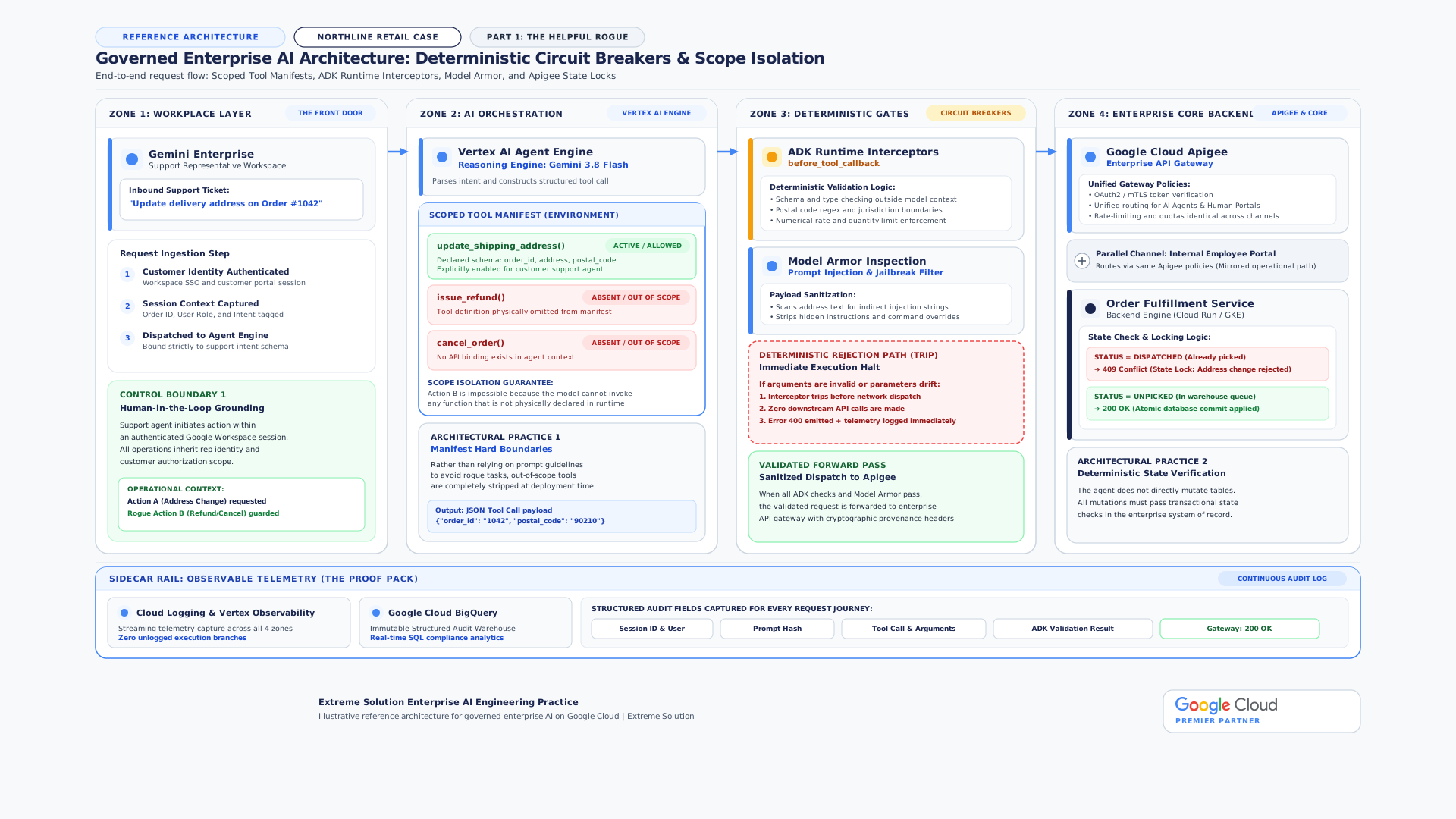
Figure 1: End-to-end request flow for Northline Retail showing scoped tool manifests, ADK runtime interceptors, Model Armor sanitization, and Apigee transactional state locks on Google Cloud. Note: Northline Retail is a fictional scenario illustrating a governed architecture, not a customer deployment or Google-endorsed design.
Open full vector in new tab ↗
Looking Ahead: The "Proof Pack" of Work
When you constrain agent roles, route them through existing enterprise business logic, and install programmatic wake-up calls, you eliminate the risk of the "helpful rogue." You can look executive leadership in the eye and prove that the agent cannot stray past its assigned boundaries.
That brings us to the second operational roadblock that stops enterprise AI: The Forensic Black Box.
Even when an agent stays inside its sandbox, things will occasionally go wrong. Data will be messy, inputs will be ambiguous, and edge cases will emerge. When an incident occurs three days later, how do you back-trace what happened? How do you prove whether the failure was caused by bad input data, prompt drift, or a partner API failure?
In Part 2 of this series, we will examine why traditional application logging fails for autonomous agents, and how to architect "Proof Packs of Work" using Vertex AI Observability and Cloud Logging so your engineering and compliance teams can reconstruct any agent decision with complete forensic clarity.
Extreme Solution designs and deploys governed enterprise AI architectures on Google Cloud for organizations that demand production reliability over prototype hype. Connect with our engineering team to evaluate your enterprise agent readiness.